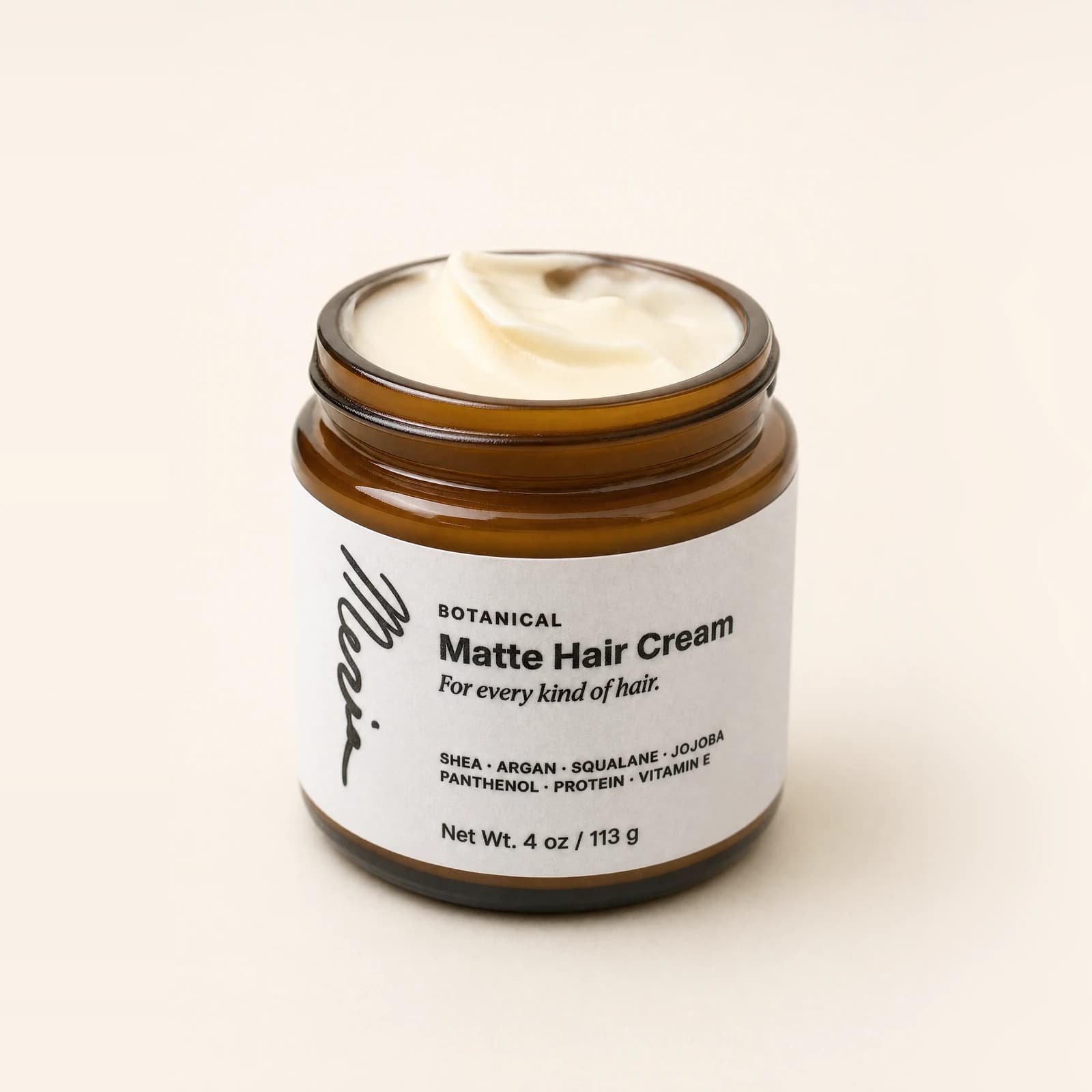
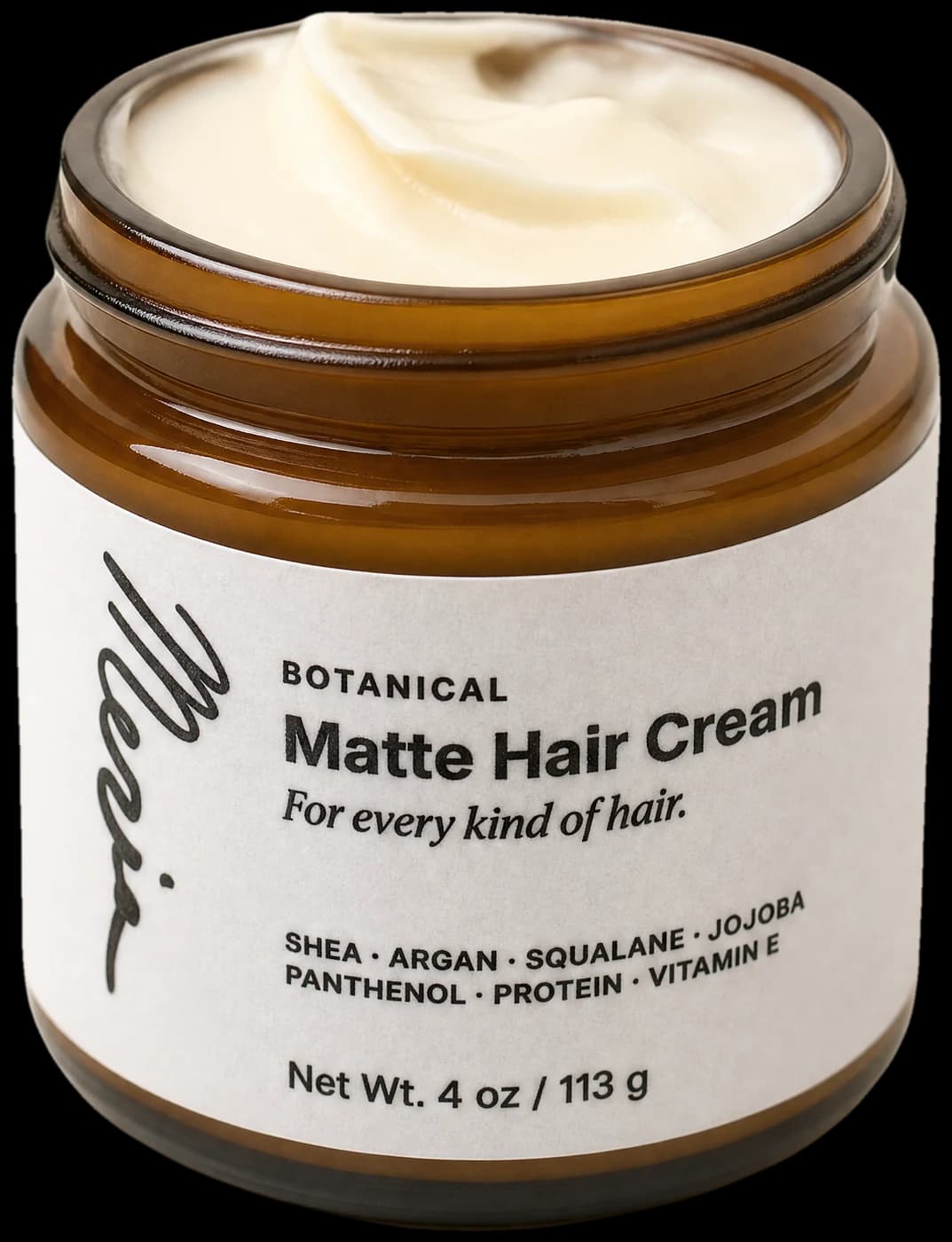
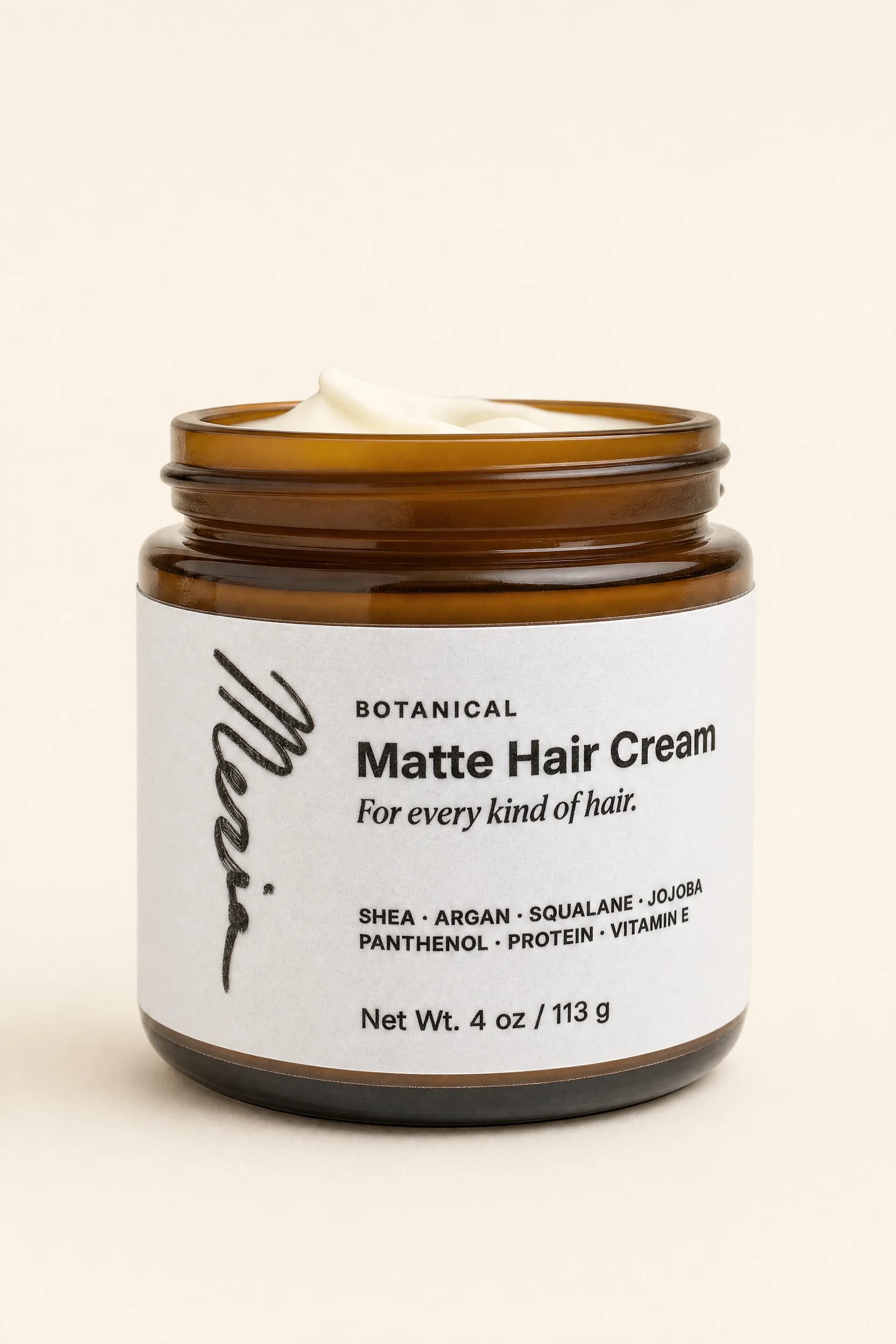
Botanical Matte Hair Cream
A silicone-free hair cream, built like skincare.
Complimentary shipping in the United States. Unopened jars may be returned within 14 days of delivery.
In brief
| For | Every kind of hair |
|---|---|
| Use | Leave in, no rinse |
| Scent | Fragrance-free |
| Silicones | None |
| Ingredients | 17, each with its amount |
| Size | 4 oz / 113 g |
What it is
A botanical leave-in cream for every kind of hair — dense in the jar, breaking instantly under the fingers, then drying light. Shea and mango butter melt in on contact, with olive squalane underneath. A conditioning emulsifier binds to the strand and stays there until the next wash. No silicones, so there is no film to clarify out. Fragrance-free. Every ingredient published, with how much of it is in the jar.
Made in Charlevoix, Michigan.
Before you buy
For external use only. Contains shea and soy, and the light liquid fraction of coconut. Patch test if sensitive.
Fragrance-free. No essential oils, no synthetic “Parfum,” nothing added for scent — only the soft, natural note of the botanical base.
Why it is built this way.
The brief was one sentence: melt into hair like butter, do something good for it, and feel right on every kind of hair. Every line on the label answers to that, and to one rule: an ingredient goes in only if it does a job nothing else in the jar does, and nothing cleaner could do it better.
01
Butter, so it melts.
Shea and mango butter soften at skin temperature. The cream breaks the moment it meets your fingers and disappears into the hair instead of sitting on it.
02
A conditioner that holds on.
Behentrimonium methosulfate binds to the strand and stays until the next wash. It is the softness a silicone fakes with a film, without the film to clarify out.
03
Skin-grade, because it touches skin.
The scalp is skin, so every ingredient is chosen to the standard of a face cream, and the directions say roots to ends.
04
Nothing for show.
No fragrance, no essential oils, no silicones, and no extract added in a pinch to be named on the front. If an ingredient’s only job is the label, it is not in the jar.
05
Checked past the label.
Every raw material is checked against a published clean-beauty standard, including the preservatives that can arrive hidden inside another ingredient.
06
One job, done properly.
Shine and hold are left out on purpose. A drop of oil adds shine; this cream does the softness and the feel, and nothing else gets in its way.
The whole label, by amount.
Every ingredient on the label, in order, with how much of it is in the jar and the reason it is there. Nothing is left off.
WaterThe carrierthe carrier, and most of the jar
Aqua (Water)
Other creams give their water a trademarked name and a backstory. Meria calls it water. It is listed first because there is the most of it, and it carries everything else: the butters and oils, held through it as fine droplets, and the ingredients that only dissolve in water, the panthenol and the betaine. Without it the jar would be a solid balm. That is the whole secret. It is also why a pea-size amount reaches through a whole head of hair and dries light instead of sitting greasy.
Shea butterMajora major ingredient
Butyrospermum Parkii (Shea) Butter
The melt-in. A butter that softens at skin temperature, so the cream breaks down on contact instead of sitting on the strand.
Fatty alcoholMajora major ingredient
Cetyl Alcohol
Not the drying kind. The fatty alcohol that gives the cream its body. Part is added on its own and part arrives inside the conditioning emulsifier.
Olive squalaneKeya key ingredient
Squalane
Olive-derived. Absorbs rather than sitting on top, which is what separates a cream that softens from one that coats.
Conditioning emulsifierKeya key ingredient
Behentrimonium Methosulfate
The conditioning emulsifier. It is what makes the cream a cream and what makes hair comb out — not a sulfate, despite the name.
Mango butterKeya key ingredient
Mangifera Indica (Mango) Seed Butter
Firmer than shea, lighter than most butters, and low in odour. Body without heaviness.
Fractionated coconutSupportinga supporting ingredient
Caprylic/Capric Triglyceride
The light liquid fraction of coconut. It helps the cream spread through hair, and it is the reason this cream is not coconut-free.
GluconolactoneSupportinga supporting ingredient
Gluconolactone
Part of the preservative system, with sodium benzoate and calcium gluconate. A cream that is mostly water will spoil without one — this is the gentler way to prevent that.
Provitamin B5Supportinga supporting ingredient
Panthenol
Provitamin B5, at a working level rather than a trace. Holds water in the strand.
BetaineSupportinga supporting ingredient
Betaine
A humectant from sugar beet. Holds hydration without the tack glycerin can leave.
Caprylyl glycolMinora minor ingredient
Caprylyl Glycol
A humectant that also makes the preservative system work harder than it could alone.
Butylene glycolMinora minor ingredient
Butylene Glycol
A carrier that arrives inside the conditioning emulsifier and helps it disperse evenly.
Sodium benzoateMinora minor ingredient
Sodium Benzoate
Part of the preservative system. Unglamorous and necessary: an unpreserved water-based cream grows things within days.
Lactic acidMinora minor ingredient
Lactic Acid
Added a few drops at a time until the cream reaches its measured pH. The same acid the skin's own surface uses.
Vitamin EMinora minor ingredient
Tocopherol
Vitamin E. It keeps the oils in the jar from going off.
Calcium gluconateMinora minor ingredient
Calcium Gluconate
Part of the preservative blend, named because it is in the jar.
PantolactoneTracea trace
Pantolactone
A trace that arrives with the provitamin B5, listed rather than left off.
Amounts are shown as bands, not exact figures. The order is by weight, as on every label, and each level shows the scale. Tap an ingredient for its label name and the reason it is there. The exact recipe is kept private so it cannot be copied; nothing in the jar is unnamed or left off this list. Fragrance-free: no essential oils, no synthetic “Parfum.”
The full list
Aqua (Water), Butyrospermum Parkii (Shea) Butter, Cetyl Alcohol, Squalane, Behentrimonium Methosulfate, Mangifera Indica (Mango) Seed Butter, Caprylic/Capric Triglyceride, Gluconolactone, Panthenol, Betaine, Caprylyl Glycol, Butylene Glycol, Sodium Benzoate, Lactic Acid, Tocopherol, Calcium Gluconate, Pantolactone
Dense in the jar. Light on the hair.
Thick in the jar does not have to mean heavy on the hair, and this formulation is built on that premise rather than around it. The body comes from a gel network — two fatty alcohols set up with a conditioning emulsifier — which is dense at rest and breaks the moment it meets finger shear. That is why a very small amount distributes. Behentrimonium methosulfate binds to the strand and stays there until the next wash, so the conditioning is on the hair rather than in the jar; olive squalane absorbs instead of sitting on top. Many styling creams get their slip from a silicone that does not dissolve in water, which can build up until hair needs clarifying to feel clean. There is no silicone here, so there is no silicone film to clarify out.
To use
Start with less than you think — a pea-size amount, warmed between the palms and worked through damp or dry hair. Add more only if the ends ask for it. No rinse needed — it’s scalp-safe from roots to ends.
What it leaves out
- Silicones
- Sulfates
- Parabens
- Added fragrance
- Petroleum
- PEGs
- Phthalates
What it will not do.
- It will not glue your hair in place, then sell you the shampoo that gets it out.
- It will not make your pillow smell like a barbershop.
- It will not tell you to keep it off your scalp.
What a silicone-free styling cream does instead
A silicone smooths by laying a film along the strand. That film is why hair feels slick the moment it goes on, and why it eventually needs a clarifying wash to come off. It is the standard approach: of 66 leave-in styling products whose ingredient lists were read from the brands’ own pages in September 2026, 25 carried at least one silicone.
This cream builds its body from a gel network instead — cetyl alcohol set with behentrimonium methosulfate, the conditioning emulsifier that binds to the strand and combs out rather than coating it. Shea and mango butter soften at skin temperature, so they melt in on contact, and olive squalane absorbs rather than sitting on top. Nothing in it needs to be stripped out later.
What it does not do is hold. There is no wax, no gel former and no silicone, so it will not set a shape or keep one. It smooths, softens and makes hair easier to comb — styling by feel rather than by hold. If a stiff finish is the goal, this is the wrong jar.
Because it is built from skin-grade ingredients, the directions permit the roots instead of avoiding them: the scalp is skin. Start with less than you think — a pea-size amount warmed between the palms, through damp or dry hair. How silicone buildup actually works.
Questions, answered.
Is it a styling cream?
It is a leave-in cream that smooths and softens; it is not a hold product. There is no wax, no gel former and no silicone in it, so it will not set a shape or keep one. What it does is make hair easier to live with — softer, easier to comb, with nothing left behind to clarify out. Start with less than you think.
Can I use this on my scalp?
Yes, and the directions say so rather than leaving you to guess. It’s formulated with skin-grade ingredients, so it can go right at the roots — the scalp is skin, and Meria built the formula that way. For context: of 74 leave-in styling products surveyed in September 2026, 46 said nothing about the scalp at all and 15 explicitly permitted root use. Most labels leave the question open; this one answers it.
What does it actually feel like?
It melts in like butter. On damp hair it disappears almost immediately, and what’s left is hair that feels genuinely softer — not coated-soft, actually soft. It’s built to stay that way through the day rather than drying out by evening.
Does it have a scent?
No. It’s fragrance-free — no essential oils, no synthetic “Parfum,” nothing added for scent at all. What you notice is the botanical base itself, and it fades to nothing.
Does it cause buildup?
There are no silicones or heavy waxes in it — those are the film-formers that coat the cuticle and accumulate until hair needs a clarifying treatment. What conditioning it leaves behind is designed to come out with ordinary shampoo.
What hair types is it for?
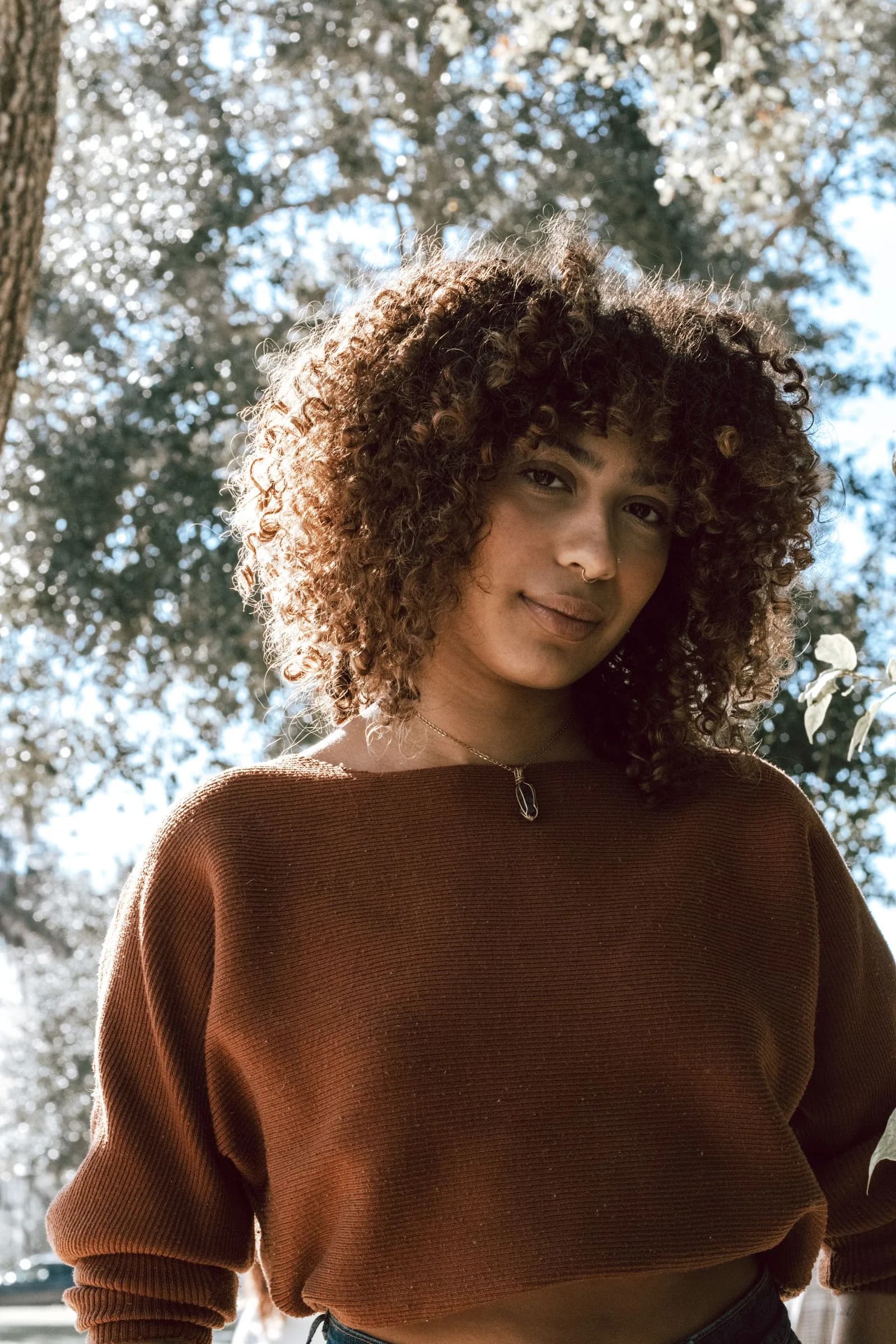
All of them — short hair, curly, medium and long. It’s an everyday cream rather than a heavy-hold styler: the priority is how the hair feels, not how firmly it’s held. What it does is make hair feel softer and silkier than it does bare.
Is it coconut-free?
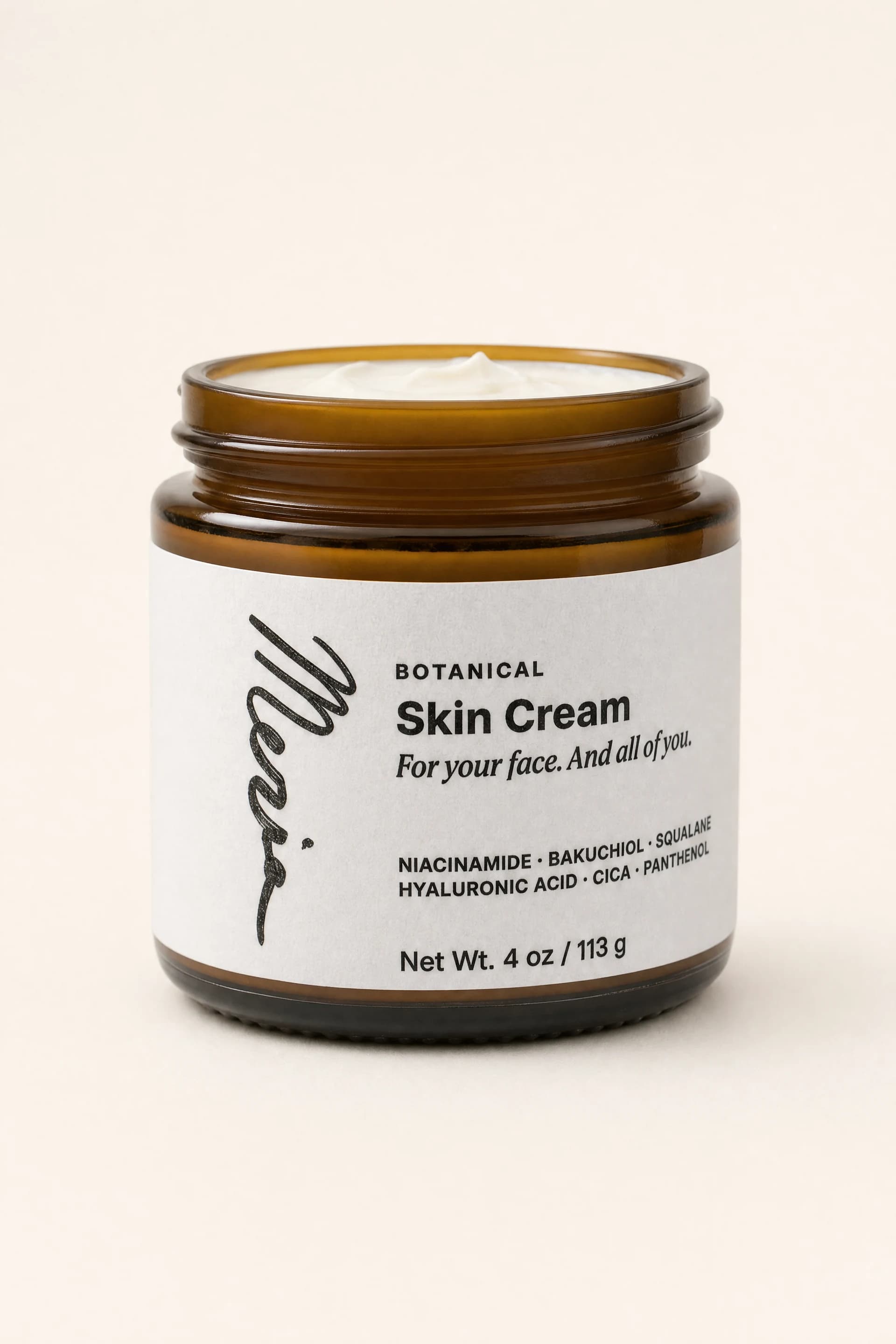
No — the hair cream contains caprylic/capric triglyceride, the light liquid fraction of coconut. The Botanical Skin Cream is made without coconut oil.
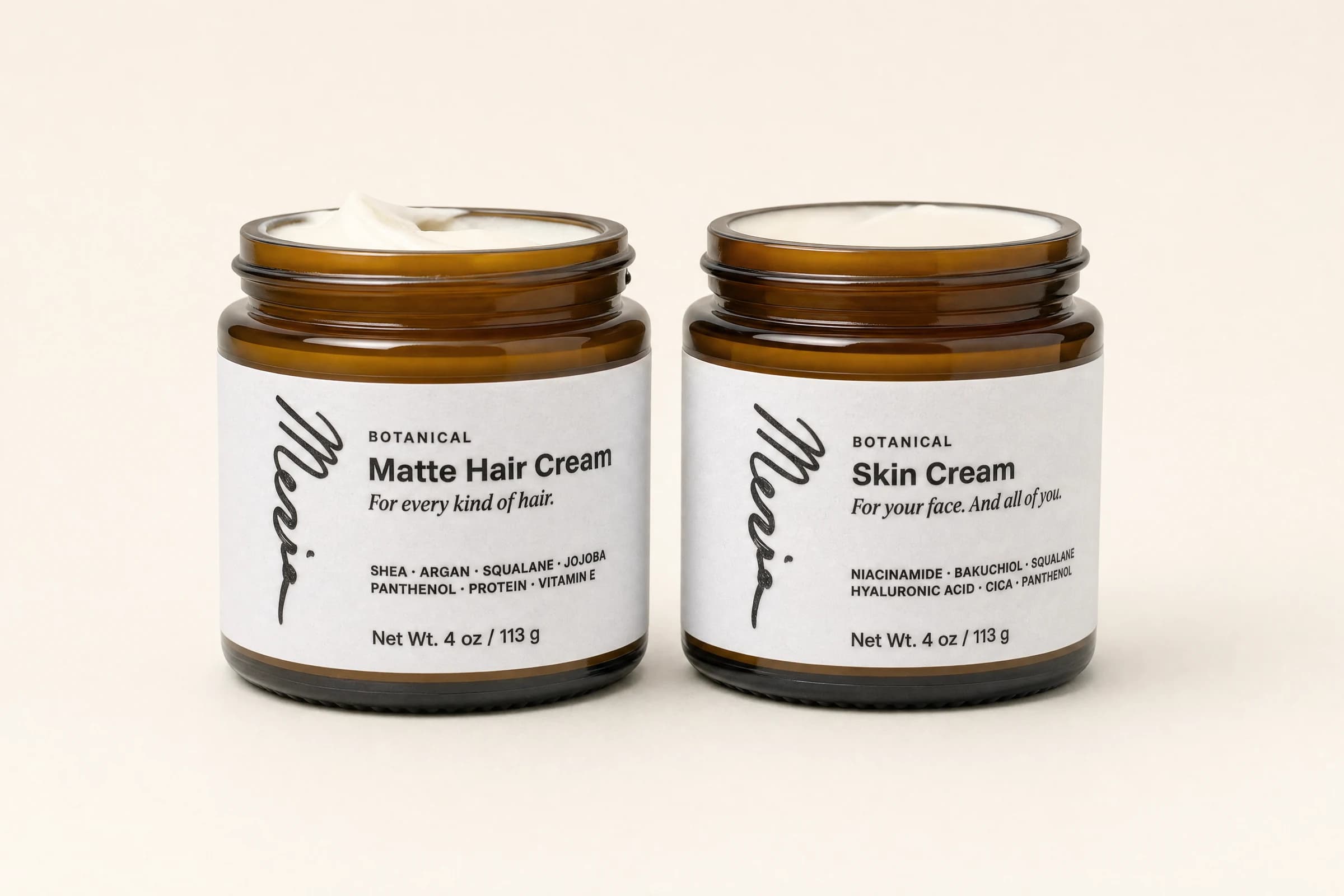
Both creams, together.
The pair is $140, $16 less than apart.