A leave-in for wavy hair that won't weigh it down
They knot like curls and flatten like straight hair. Why it happens after every shower, and what fixes it.
Meria Learn · November 12, 2026 · 7 min read
Wavy hair tangles after a shower because wet hair is softer and weaker than dry hair, so strands catch and knot more easily. It goes flat when there is more product on it than it can carry, usually too much, too close to the roots.
Use less leave-in than you think, put it into soaking-wet hair from the mid-lengths down, and detangle once it is in. The rest of this issue is the why.
Why waves tangle after the shower
Water softens the strand.
Wet hair breaks under less force than dry hair and wears faster when it rubs against itself, a comb or a towel.
A wave gives it more places to catch.
Straight strands slide past each other. Waves cross, and every crossing is a place for a knot to start.
The towel finishes the job.
Rubbing twists wet strands around each other. Press the water out, or wrap the hair and let the towel drink it.
Hard water may add to it. Some lab studies found hair washed in hard water weaker than hair washed in purified water; others found no difference. If tangles got worse after a move, the water is worth a look.

Waves don't need more product. They need it in the right place.
Why waves go flat
Too much
Waves are light. The most common reason they drop is simply too much of a good product.
Too high
The wave starts a few inches below the root. Weight at the top pulls every wave under it straight.
Too many
Leave-in, then oil, then cream, then gel. Each might be fine alone; together they weigh more than a wave can lift.
The wave map
Where a leave-in goes, and how much, is most of the answer. A good leave-in for waves spreads from a small amount, melts in rather than sitting on top, gives the comb slip, and washes out with your shampoo. Silicones give slip very well; so do conditioners like behentrimonium methosulfate. What matters is that the comb runs through.
Roots
None. The wave starts lower down.
Mid-lengths
Start here, while hair is soaking wet.
Ends
The most. The oldest, driest hair.
½ tsp
Short or fine waves
1 tsp
Long or thick waves
The ingredient edit
Meria Botanical Hair Cream, in label order, read for waves. Where a study on hair exists it is linked, with what it tested. Where nobody has studied an ingredient on hair yet, the entry says what it does and stops there.
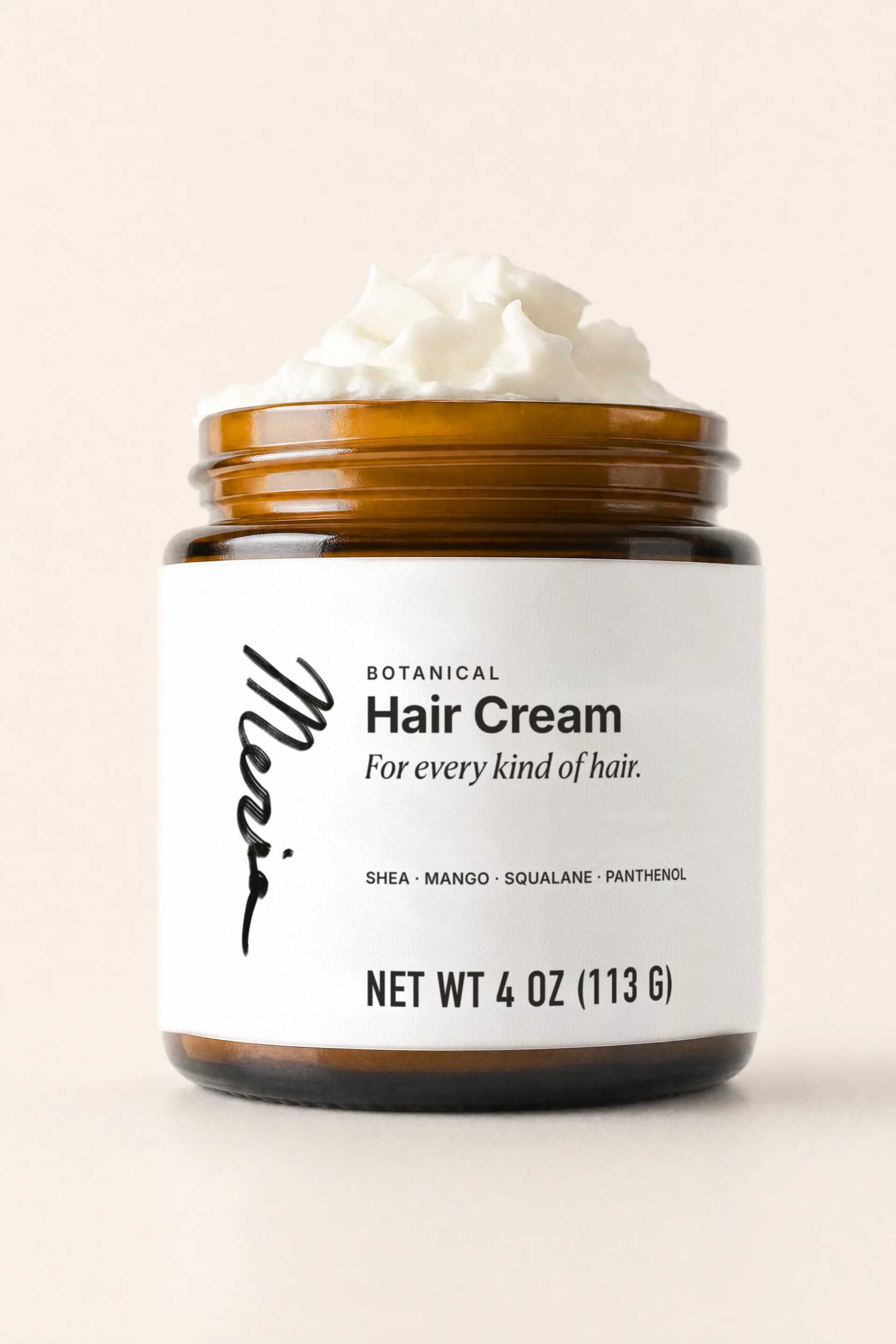
Botanical Hair Cream4 oz / 113 g
$68- 1
Water
Water (Aqua)
First on the label, so the cream is light. It carries the butters as fine droplets, which is why half a teaspoon reaches through a whole head of waves and dries without weight.
- 2
Shea butter
Butyrospermum Parkii (Shea) Butter
Softens at skin temperature, so it melts and spreads thin between your palms instead of landing on one section of hair in a clump.
- 3
Cetyl alcohol
Cetyl Alcohol
A fatty alcohol, not the drying kind. With the conditioner it builds the soft structure that gives the cream its body and lets it break down the moment you work it between your fingers.
How that structure forms, lab study - 4
Olive squalane
Squalane
A light, dry-feeling oil. Slip without the greasy weight that pulls a wave straight.
- 5
Behentrimonium methosulfate
Behentrimonium Methosulfate
The detangler. Wet hair carries a negative charge and this conditioner a positive one, so it settles onto the strand and lowers the friction that makes waves knot. In a 2026 lab study on hair, behentrimonium conditioners deposited more than shorter-chain ones.
Tham et al. 2026, Int J Cosmet Sci - 6
Mango butter
Mangifera Indica (Mango) Seed Butter
Mostly stearic and oleic acid. The stearic makes it firmer than shea, which gives the cream its body in the jar; it melts close to body temperature, so it turns soft in your palms and goes on thin rather than heavy.
Mango kernel fat review, 2016 - 7
Fractionated coconut
Caprylic/Capric Triglyceride
A clear, very thin oil made from medium-length fatty acids. It loosens the butters so the cream travels the full length of a wave instead of stopping where your hand lands, and because those fatty acids are fully saturated, it resists going rancid.
Ingredient technical data (BASF) - 8
Argan oil
Argania Spinosa Kernel Oil
A small amount of certified organic argan oil for slip and a touch of sheen. In a lab study on coloured hair, a hair-care base with argan oil reduced protein loss after dyeing.
JCDSA 2013, lab study - 9
Provitamin B5
Panthenol
Small enough to get inside the strand. In a 2026 lab study it reached the hair’s inner cortex, and treated strands took more force to break: worth having on hair that is most fragile when wet.
Marsh et al. 2026, Int J Cosmet Sci - 10
Betaine
Betaine
A humectant from sugar beet. Holds water without the tacky feel that makes waves crunchy.
- 11
Lactic acid
Lactic Acid
Added drop by drop to bring the cream to a mildly acidic pH. Researchers link a lower pH to less negative charge on the hair surface, and so to less friction between strands.
Gavazzoni Dias et al. 2014, review And the ones that keep it safe
- Gluconolactone, sodium benzoate and calcium gluconate keep a water-based cream safe from the first scoop to the last.
- Caprylyl glycol and butylene glycol help the preservative and spread the conditioning evenly.
- Vitamin E, carried in soybean oil, keeps the oils from going off.
- Pantolactone is a trace that arrives with the provitamin B5.
No silicone, no wax, no gel former, nothing added for scent. See the full label
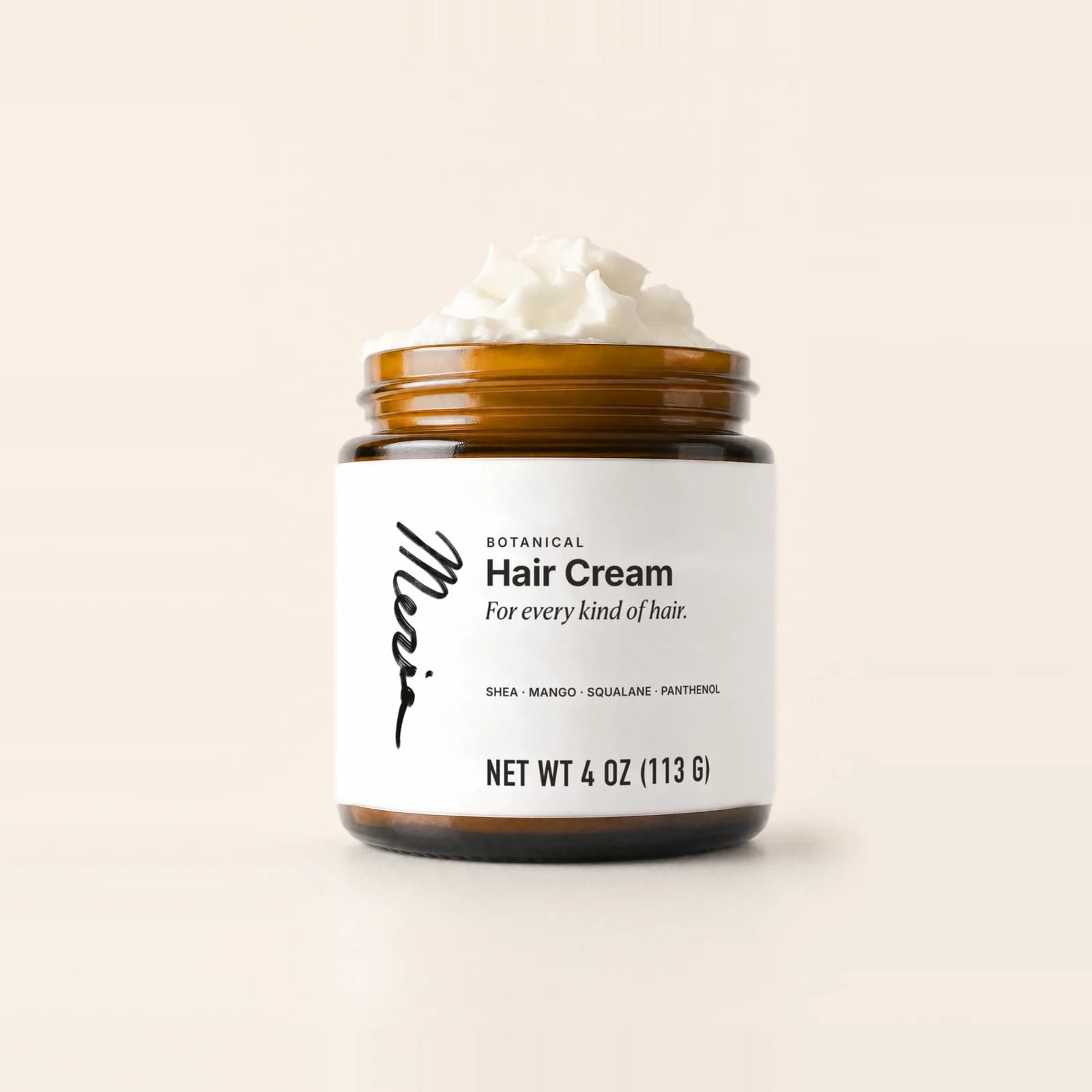
Softer, easier to comb, light enough for waves.
A leave-in conditioning cream for every kind of hair. It melts on contact, detangles, and washes out. It is not a styler: it won't set a wave or add hold.
Free US shipping.
The routine, after every shower
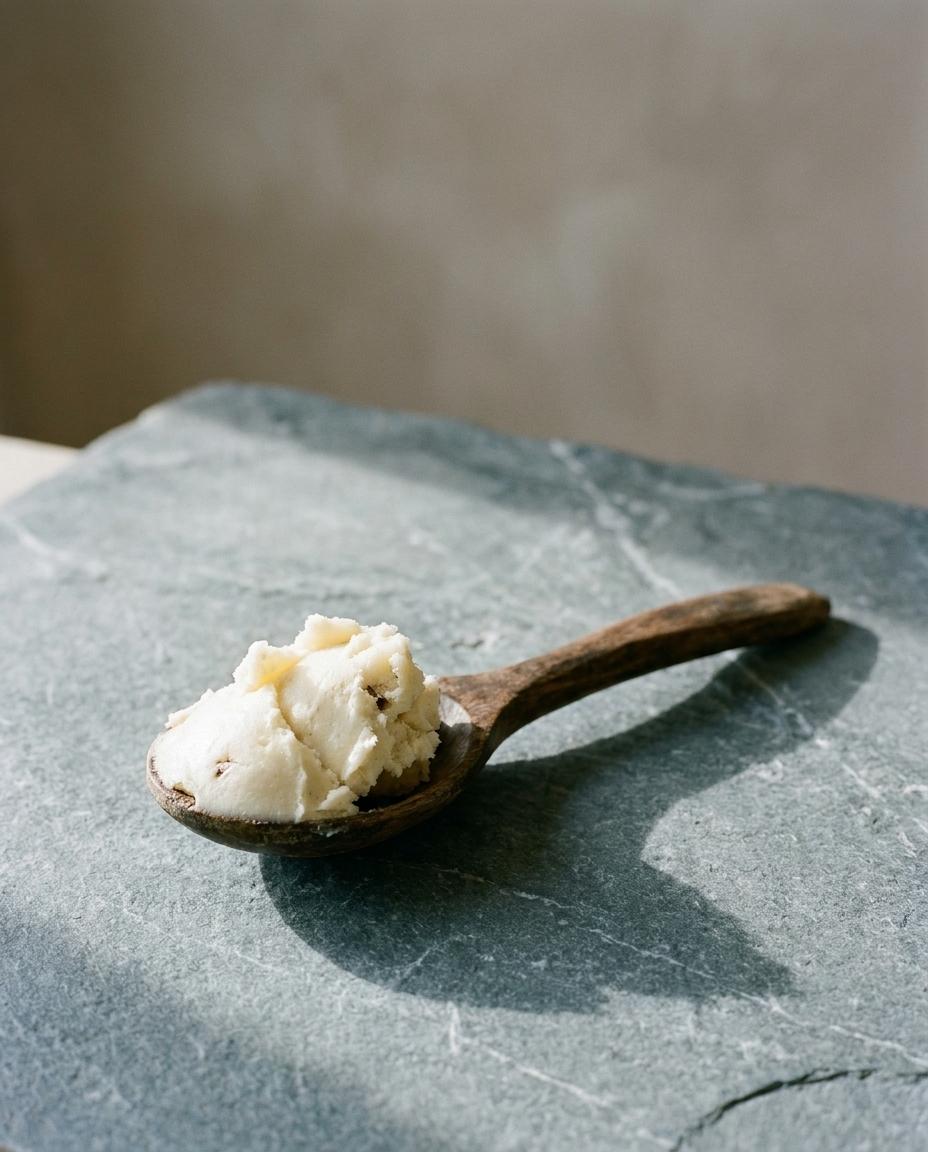
Shea butter softens at skin temperature. Warm the cream between your palms first and it spreads thin.
- 1Out of the shower, press the water out with a towel or a cotton T-shirt. No rubbing.
- 2Warm the cream between your palms until it melts: half a teaspoon for short or fine waves, a teaspoon for long or thick.
- 3Rake it through the mid-lengths and ends while hair is still soaking wet. Leave the roots alone.
- 4Detangle now, with the cream in: fingers or a wide-tooth comb, starting at the ends and working up.
- 5Scrunch upward and let it dry, or diffuse. For definition or hold, add a gel or mousse over it.
Questions
- Should leave-in go on wet or damp hair?
- On wavy hair, wetter is usually better. Water helps a small amount spread evenly, so the wave gets conditioning without a heavy patch anywhere.
- How much leave-in should I use on wavy hair?
- Less than you think. With Meria Botanical Hair Cream, half a teaspoon for short or fine waves and a teaspoon for long or thick waves, from the mid-lengths to the ends. Add more only where hair still feels dry once it has dried.
- Can I use a leave-in every day?
- Yes, if your shampoo washes it out. Use the smallest amount that leaves hair soft.
- Why is my hair puffy after the shower?
- Usually it dried without enough conditioning, or it was rubbed with a towel. Press the water out instead of rubbing, work a little leave-in through the wet lengths, and detangle with it in.
- Will a leave-in cream define my waves?
- A conditioning cream softens and detangles; it does not hold a shape. If you want definition, scrunch it in while hair is wet and add a gel or mousse over it.
Read next
- How to Reduce Frizz Without Silicones
- Why Your Hair Feels Greasy After Styling Products
- Silicone in hair: which kinds build up
- The Botanical Hair Cream, full label
Sources
- 1Tham HP et al. Cationic conditioning surfactants on hair. Int J Cosmet Sci, 2026;48:379–93. Lab study; tested at 1% active in a rinse-off conditioner. Read it
- 2Marsh JM et al. Panthenol in the hair cortex. Int J Cosmet Sci, 2026;48:121–7. Lab study; co-authors from Procter & Gamble. Read it
- 3Hair protective effect of argan oil and cupuassu butter after hair dye. J Cosmet Dermatol Sci Appl, 2013;3:40–44. Lab study on dyed hair. Read it
- 4Gavazzoni Dias MF et al. The shampoo pH can affect the hair: myth or reality? Int J Trichology, 2014;6:95–9. Survey and review of the friction mechanism. Read it
- 5Gavazzoni Dias MF. Hair cosmetics: an overview. Int J Trichology, 2015;7:2–15. How conditioners lower friction and combing force. Read it
- 6Promising features of mango (Mangifera indica L.) kernel oil: a review. J Food Sci Technol, 2016. Fatty acid make-up and melting behaviour. Read it
- 7Caprylic/capric triglyceride technical data (Myritol 318, BASF). Supplier data, not an independent study. Read it
- 8Patel HK et al. Gel network of cetostearyl alcohol and a cationic surfactant. J Pharm Pharmacol, 1985;37:899–902. Read it
- 9Wet and dry hair fracture and combing breakage. Journal of the Society of Cosmetic Chemists, 29:8 and 58:4. Read it
Photographs of hair are illustrative (Pexels). Nothing here is medical advice.