It Feels Better When You Know What You're Putting on Your Hair and Body
Full transparency on what goes in—and why
The short answer
There's a particular kind of relief that comes from understanding exactly what's in the products you use every day. Not a vague sense that something is 'natural'—those words have been stretched to meaninglessness. But actual clarity. Knowing the ingredients. Understanding why they're there.
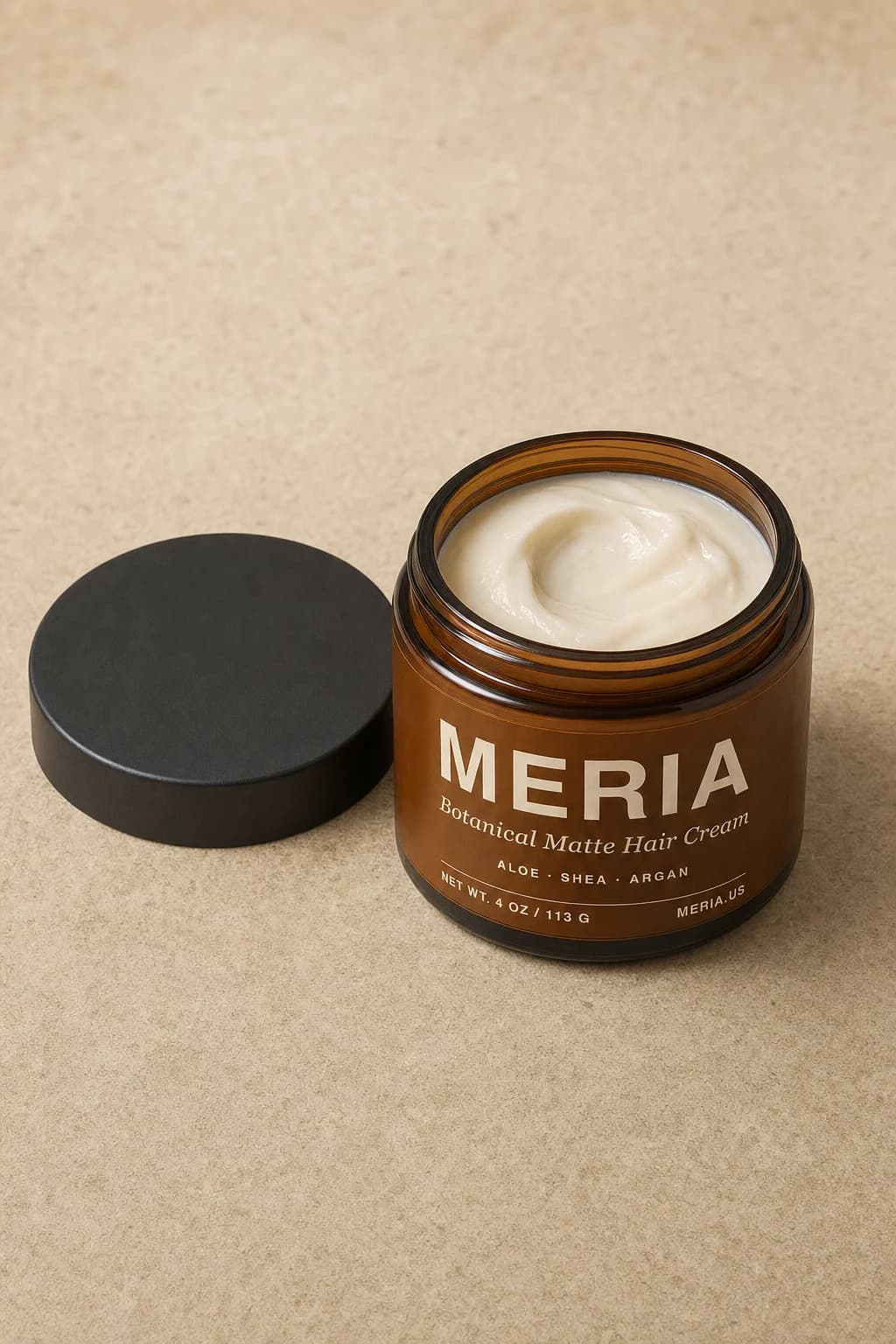
Botanical Matte Hair Cream
A silicone-free hair cream, built like skincare.
There's a particular kind of relief that comes from understanding exactly what's in the products you use every day.
Not a vague sense that something is "natural" or "clean"—those words have been stretched to meaninglessness. But actual clarity. Knowing the ingredients. Understanding why they're there. And feeling good about the answer.
That is what Meria built.
The Problem with "Parfum"
You've seen it on ingredient lists: parfum or fragrance. One word that can represent dozens—sometimes hundreds—of undisclosed chemicals.
It's technically legal. Fragrance formulas are considered trade secrets. But it creates a strange relationship with the products you put on your body every day. You're trusting something you can't fully see.
For some people, this never becomes an issue. For others, there is a slow accumulation of questions. A sense that the prices are real but the disclosures are not.
Meria contains no synthetic fragrance and no essential oils. Both creams are fragrance-free — nothing is added for scent at all. What you notice on application is the botanical base itself, and it fades as the cream absorbs.
The Filler Problem
Most hair products—even expensive ones—are built on a foundation of low-cost filler ingredients. Water and thickeners make up the bulk. The "active" ingredients that justify the price point are often present in small amounts, listed near the end.
It is not necessarily harmful. But over time, it can feel like a mismatch. The price is real; the formulation is mostly water and thickener. The jar empties, another is bought, and the question quietly accumulates: is this paying for the formulation or paying for the marketing?
Meria built the cream differently. Water is named first, because that is where it is, and every ingredient after it is published with how much of it is in the jar — shea and mango butter, olive squalane, provitamin B5 at a working level rather than a trace. The emulsifiers are the same grade used in facial skincare. Every ingredient earns its place on the label.
The result is a cream that rewards generous use. There is no small amount of “good stuff” to be stretched. The whole jar is the formulation.
Haircare Held to Skincare Standards
The skincare industry has spent decades refining what makes a formula effective and safe for skin. Absorption rates. Emulsifier technology. Compatibility with the skin barrier. These concepts drive formulation in serious skincare.
Haircare hasn't followed the same path. Most hair products are formulated for performance on the hair shaft, with minimal consideration for the skin they inevitably touch.
The question Meria asked: what if hair cream were held to skincare standards?
Meria is the result. Face-cream-grade emulsifiers. Ingredients that absorb rather than coat. A formula designed to be safe at the roots, on the scalp, and anywhere it touches your skin.
The Relief of Generous Use
There's something uncomfortable about products you have to use sparingly. That constant mental math—is this enough? Is this too much?—adds friction to something that should be simple.
Meria was designed to feel better the more you use it. There's no penalty for applying at the roots. No buildup from daily use. No regret from working it through thoroughly.
This is what happens when formulation prioritizes absorption over coating. The product integrates with your hair instead of accumulating on top of it.
Complete Ingredient Disclosure
Here's everything in Meria Botanical Matte Hair Cream, and why:
Aqua (Water) — Water. Other creams give their water a trademarked name and a backstory. Meria calls it water. It is listed first because there is the most of it, and it carries everything else: the butters and oils, held through it as fine droplets, and the ingredients that only dissolve in water: panthenol and betaine in both, niacinamide in the skin cream. Without it each jar would be a solid balm. That is the whole secret.
Butyrospermum Parkii (Shea) Butter — Shea butter. The melt-in. Softens at skin temperature, so the cream breaks down on contact instead of sitting on top.
Cetyl Alcohol — Fatty alcohol. Another fatty alcohol, not a drying one. Body and slip.
Squalane — Olive squalane. Olive-derived. Absorbs rather than sitting on top, which is what separates a cream that softens from one that coats.
Behentrimonium Methosulfate — BTMS, from rapeseed. Reads like a sulfate and is not one. It is a conditioning agent derived from rapeseed, and it is what lets the cream detangle and soften without leaving a film to clarify out.
Mangifera Indica (Mango) Seed Butter — Mango butter. The middle butter — firmer than shea, lighter than illipe, and low in odour. Body without heaviness.
Caprylic/Capric Triglyceride — The light liquid fraction of coconut. It thins the butters so the cream spreads without dragging — and it is the reason the hair cream is not coconut-free. The skin cream is formulated without it.
Gluconolactone — Part of the preservative system, with sodium benzoate and calcium gluconate. A cream that is mostly water will spoil without one — this is the gentler way to prevent that.
Panthenol — Provitamin B5. Holds water and gives the cream its slip.
Betaine — From sugar beet. A humectant from sugar beet. Holds water without the tack that glycerin alone can leave.
Caprylyl Glycol — A glycol that conditions on its own and lets the preservative system work at a lower dose than it otherwise would.
Butylene Glycol — A small solvent that arrives inside the conditioning emulsifier and helps it disperse evenly.
Sodium Benzoate — Part of the preservative system. Unglamorous and necessary: an unpreserved water-based cream grows things within days.
Lactic Acid — Added to bring the finished cream to a measured pH rather than to a fixed weight, which is why its figure is nominal. The same acid the skin's own surface uses.
Tocopherol — Vitamin E. An antioxidant. Its first job is keeping the oils in the jar from oxidising, which is what makes a natural formula go off.
Calcium Gluconate — Part of the preservative blend, named because it is in the jar. A mineral salt of gluconic acid, the same family as the gluconolactone beside it.
Pantolactone — A trace that arrives with the provitamin B5. It is part of how panthenol is made, so it is listed rather than left off.
That's it. Nothing hidden. Nothing left unexplained.
Knowing What You're Putting on Your Body
Your scalp is skin. Your hair grows from skin. The products you apply to your hair touch your skin, sit on your skin, and become part of your daily exposure.
When you know exactly what those products contain—and when you feel good about the answer—something shifts. The routine becomes simpler. The trust becomes real.
That's what Meria set out to make. Not a product you use despite its ingredients, but a product you use because of them.
Meria Botanical Matte Hair Cream. Ingredients you can read, understand, and trust.
Dense in the jar. Light on the hair.
Thick in the jar does not have to mean heavy on the hair, and this formulation is built on that premise rather than around it. The body comes from a gel network — two fatty alcohols set up with a conditioning emulsifier — which is dense at rest and breaks the moment it meets finger shear. That is why a very small amount distributes. Behentrimonium methosulfate binds to the strand and stays there until the next wash, so the conditioning is on the hair rather than in the jar; olive squalane absorbs instead of sitting on top. Many styling creams get their slip from a silicone that does not dissolve in water, which can build up until hair needs clarifying to feel clean. There is no silicone here, so there is no silicone film to clarify out.
4 oz / 113 g · 17 ingredients, each one published with the reason it is in there.
Questions
- Why don't you just use 'fragrance' like other brands?
- Because 'fragrance' can represent dozens of undisclosed chemicals, and because neither cream needs one. Both are fragrance-free — no essential oils, no synthetic fragrance, no masking agents. Everything in the jar is on the label, and none of it is there for scent.
- Are your ingredients really the same quality as skincare?
- Yes. The emulsifiers are the kind used in facial skincare, and every ingredient is named on the label with the reason it is there.
- What if I have sensitivities to certain ingredients?
- Because everything is listed, you can actually check. No hidden 'fragrance' compounds, no undisclosed preservatives. If you know what you react to, you can see whether it is in the formula.