Best Matte Styling Cream for Fine Hair: What to Look For
Finding products that add texture without weighing hair down
The short answer
Fine hair is carried by weight, so what matters is how little of a product it takes and what stays behind. Two routes go matte: a fine powder such as arrowroot or kaolin scattering the light, or a light base that dries down without a film. Powders do absorb oil, which can read dry by evening, and Meria's cream carries neither for that reason. Avoid petroleum and mineral oil, and read where the fats sit on the label.
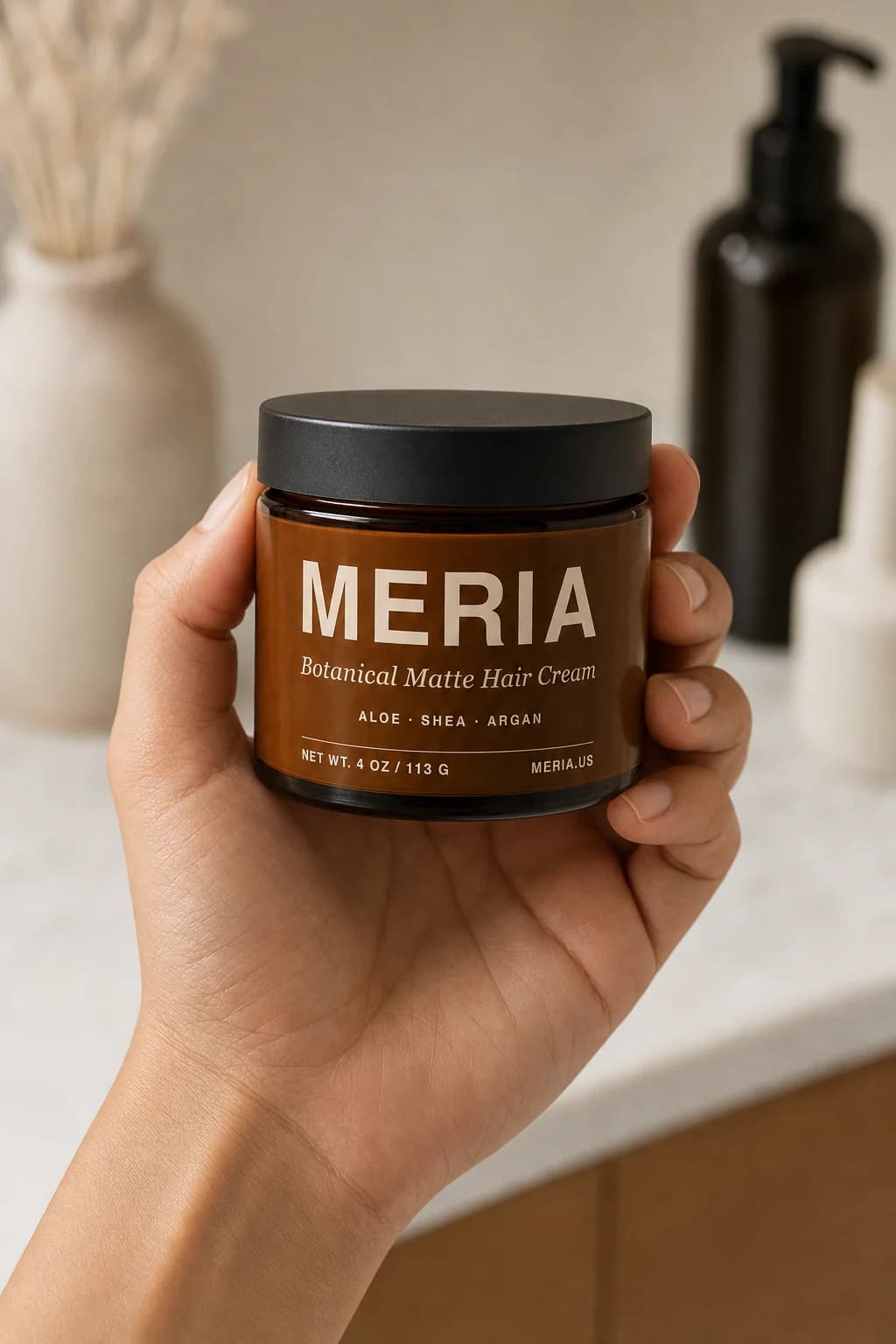
Botanical Matte Hair Cream
A silicone-free hair cream, built like skincare.
Why Fine Hair Needs Different Products
Fine hair has less surface area per strand than thick hair. This means products designed for "average" hair can easily overwhelm fine strands, causing them to clump together, lay flat, or look greasy.
The challenge with fine hair is adding texture and hold without adding weight. Most styling products do both — but fine hair needs products that maximize texture while minimizing weight.
What Weighs Fine Hair Down
These ingredients are fine for thick hair but problematic for fine hair:
Heavy Oils
Mineral oil, petroleum, coconut oil, and castor oil add shine and conditioning — but they're too heavy for fine hair. They'll cause strands to clump and lay flat.
Silicones
Silicones (dimethicone, cyclomethicone, etc.) coat the hair shaft. On fine hair, this coating adds noticeable weight and can make hair look limp and lifeless over time.
Heavy Waxes
Beeswax and carnauba wax provide hold but add significant weight. They can also be difficult to wash out, leading to buildup that compounds the problem.
Over-Conditioning
Some styling products include heavy conditioning agents that are great for damaged or thick hair but overwhelming for fine hair. If your styling product makes hair feel "too soft," it's probably over-conditioned.
What to Look For Instead
The best matte creams for fine hair share these characteristics:
Lightweight Base
Look for products with water as the first ingredient rather than heavy butters or oils. A water-based cream spreads thinly and leaves less weight behind.
Oil-Absorbing Ingredients
Ingredients like arrowroot powder and kaolin clay actually remove oil rather than adding it. This creates texture and volume while preventing the greasiness that weighs fine hair down.
True Matte Finish
Some products claim "matte" or "low shine" but still contain silicones or oils. True matte products use oil-absorbing ingredients that create genuine matte texture.
Easy Washout
Products that wash out easily don't cause buildup. For fine hair, buildup is especially problematic because it adds weight that can't be styled away.
Ingredients Checklist for Fine Hair
When evaluating a matte cream for fine hair, check for:
Look For
- • Water as the first ingredient
- • Butters and oils further down the list, not first
- • A small amount needed per use
- • Panthenol (vitamin B5)
Avoid
- • Mineral oil / petroleum
- • Heavy waxes
- • Silicones (-cone ingredients)
- • Coconut oil (comedogenic)
- • Castor oil (too heavy)
Application Tips for Fine Hair
Even the right product can fail if applied incorrectly. For fine hair:
- Use less than you think — start with half of what you'd normally use
- Apply to dry hair — wet hair dilutes product and adds weight
- Warm thoroughly — rub between palms until product is thin and spreadable
- Avoid roots initially — apply to mid-lengths and ends first
- Use fingertips at roots — for lift, use just fingertips with minimal product
- Build gradually — add more only where needed
The Volume Question
Many people with fine hair want volume. The counterintuitive truth is that matte products often provide more volume than volumizing products:
- Oil-absorbing ingredients create texture that hair can "grip"
- Matte finish eliminates the weight of shine-enhancing ingredients
- Lightweight formulas don't pull hair down
- Texture creates the appearance of fullness
If you've tried volumizing products without success, a good matte cream might actually give you better results.
The Bottom Line
The best matte cream for fine hair isn't necessarily marketed "for fine hair." It's a product with the right formulation: lightweight base, oil-absorbing ingredients, no heavy waxes or silicones, and easy washout.
Focus on ingredients rather than marketing claims, and you'll find products that work with your fine hair instead of against it.
Dense in the jar. Light on the hair.
Thick in the jar does not have to mean heavy on the hair, and this formulation is built on that premise rather than around it. The body comes from a gel network — two fatty alcohols set up with a conditioning emulsifier — which is dense at rest and breaks the moment it meets finger shear. That is why a very small amount distributes. Behentrimonium methosulfate binds to the strand and stays there until the next wash, so the conditioning is on the hair rather than in the jar; olive squalane absorbs instead of sitting on top. Many styling creams get their slip from a silicone that does not dissolve in water, which can build up until hair needs clarifying to feel clean. There is no silicone here, so there is no silicone film to clarify out.
4 oz / 113 g · 17 ingredients, each one published with the reason it is in there.
Questions
- How much matte cream should I use on fine hair?
- Start with a pea-sized amount for short hair, or a small dime-sized amount for longer hair. Fine hair needs less product than thick hair — you can always add more, but you can't take it away.
- Should I apply matte cream to wet or dry fine hair?
- For fine hair, dry or barely damp is usually better. Wet hair dilutes the product and can cause it to weigh hair down more. Apply to towel-dried or fully dry hair for maximum lift and texture.
- Why does my fine hair look greasy with some matte products?
- Some 'matte' products contain silicones or heavy oils that can overwhelm fine hair. True matte products use oil-absorbing ingredients. If your matte cream makes hair greasy, the formulation isn't right for fine hair.