Meria · The creams, explained · November 2026
Soft, light and easy to comb.
Meria Botanical Hair Cream, ingredient by ingredient, with the research behind each one and why they work together.
Meria Hair Cream is a leave-in that melts into damp hair: a conditioner that settles where hair tangles, provitamin B5 that reaches inside the strand, and a gentle acidity that keeps the surface smooth. Hair dries soft, light and easy to comb, with nothing left to build up.
For every study: what was tested, on what, and how much compared with Meria Hair Cream. Most of the hair studies on this page were done in a lab on cut hair rather than on people, and each one says so. Where the researchers worked for a company, the company is named.
1Behentrimonium methosulfate, 3.5%
The conditioner, left in.
Its long name ends in “sulfate”, but it is not a cleansing sulfate. It is a conditioner with a positive charge, and the surface of hair carries a negative one, so it settles onto the strand and stays. In a 2026 lab study funded by Singapore’s A*STAR research agency, conditioners like it deposited on cut hair and lowered the force needed to comb it. That study rinsed 1% off; Meria Hair Cream leaves 3.5% in.
Some of the study’s co-authors work for Ashland, an ingredient maker. The study also found that conditioners make hair easier to manage without repairing damage, and Meria Hair Cream claims no repair.

Hair carries a negative charge.The conditioner in Meria Hair Cream is positive, so it holds on.
2Panthenol, 1%
Provitamin B5, inside the strand.
Inside
Panthenol is small enough to get into hair. In a 2026 lab study, it was imaged inside the cortex, the strand’s inner core, where it bonded to the hair’s own proteins.
Stronger
The treated hair took more force to break. The study was run on cut hair and co-written by scientists at Procter & Gamble, which makes Pantene. Its summary gives no dose, so it cannot be compared with the 1% in Meria Hair Cream.
Marsh et al., 20263pH
Gently acidic, on purpose.
The higher the pH, the more negative charge builds on the surface of hair, and that charge is part of what makes strands rub, tangle and frizz. A 2014 review from Rio de Janeiro, which measured 123 shampoos, argues that shampoos should be acidic for this reason. Meria Hair Cream is made to sit between pH 4.3 and 4.6. Gavazzoni Dias et al., 2014
More acidicMore alkaline
The link between pH and friction is the reviewers’ reading of earlier research, not a test of their own.
4Butters and oils
Rich in the jar, light on the hair.
Shea and mango butter
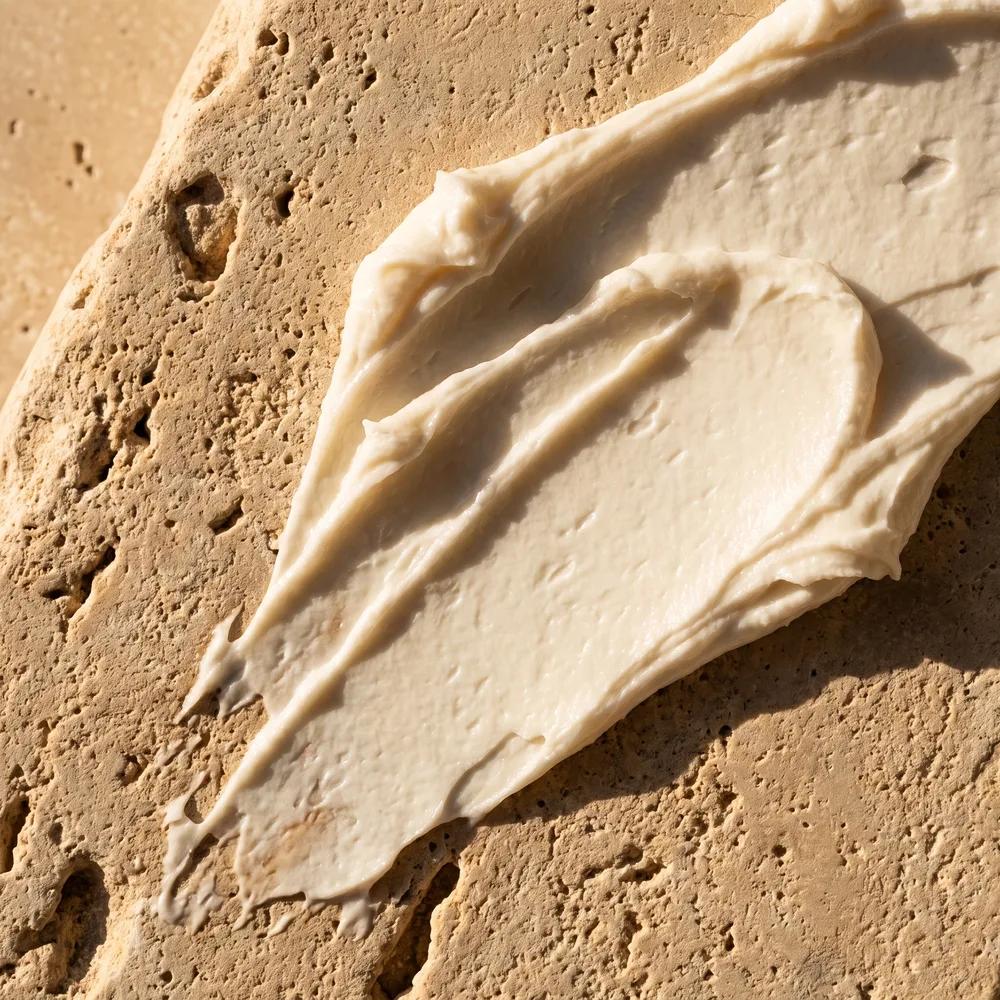
Soften in the warmth of your hands.
Both soften at skin temperature, which is why Meria Hair Cream is dense in the jar and melts in the hand. The melt is judged by hand at the bench; no study has measured either butter on hair.
Argan oil
Softness that absorbs.
In a 2022 lab test, cut hair treated with argan oil before bleaching lost significantly less protein, and the oil was still on the hair after washing. A review the same year of studies on people found no significant evidence that argan oil improves hair growth or quality.
Squalane
Light slip, no grease.
A stable form of an oil skin makes itself, chosen for its light, dry feel. No study has measured it on hair.
Together
Why these ingredients work together.
- 1
Less charge, fewer tangles.
Hair’s surface carries a negative charge, which is part of why strands rub and tangle. The positively charged conditioner settles onto it, and the gentle acidity of Meria Hair Cream lowers that charge further.
- 2
Thick in the jar, gone in the hand.
Cetyl alcohol and the conditioner build a layered structure with water. It keeps Meria Hair Cream rich in the jar and lets it give way under the fingers, which is why a little reaches through a whole head of hair.
- 3
On the strand, and inside it.
The conditioner works on the surface of each hair. Panthenol, in lab work, went into the cortex, the strand’s inner core.
- 4
Nothing left to build up.
Meria Hair Cream has no silicones, so what stays on the hair washes out with ordinary shampoo. Silicones condition well and are safe as used; leaving them out is a choice about washing clean.
No study has tested this formula as a whole. Each line above rests on the studies named on this page, most of them lab work on cut hair.
Everything in Meria Hair Cream, in label order
Water (Aqua), Butyrospermum Parkii (Shea) Butter, Cetyl Alcohol, Squalane, Behentrimonium Methosulfate, Mangifera Indica (Mango) Seed Butter, Caprylic/Capric Triglyceride, Argania Spinosa Kernel Oil, Gluconolactone, Panthenol, Betaine, Caprylyl Glycol, Butylene Glycol, Sodium Benzoate, Lactic Acid, Tocopherol, Glycine Soja (Soybean) Oil, Calcium Gluconate, Pantolactone.
In pink, the ingredients this page explains. The rest keep Meria Hair Cream safe, stable and soft: a preservative, a light coconut-derived oil, betaine for moisture, and vitamin E so the oils keep. Fragrance-free, with no essential oils and no silicones. Every ingredient, and why
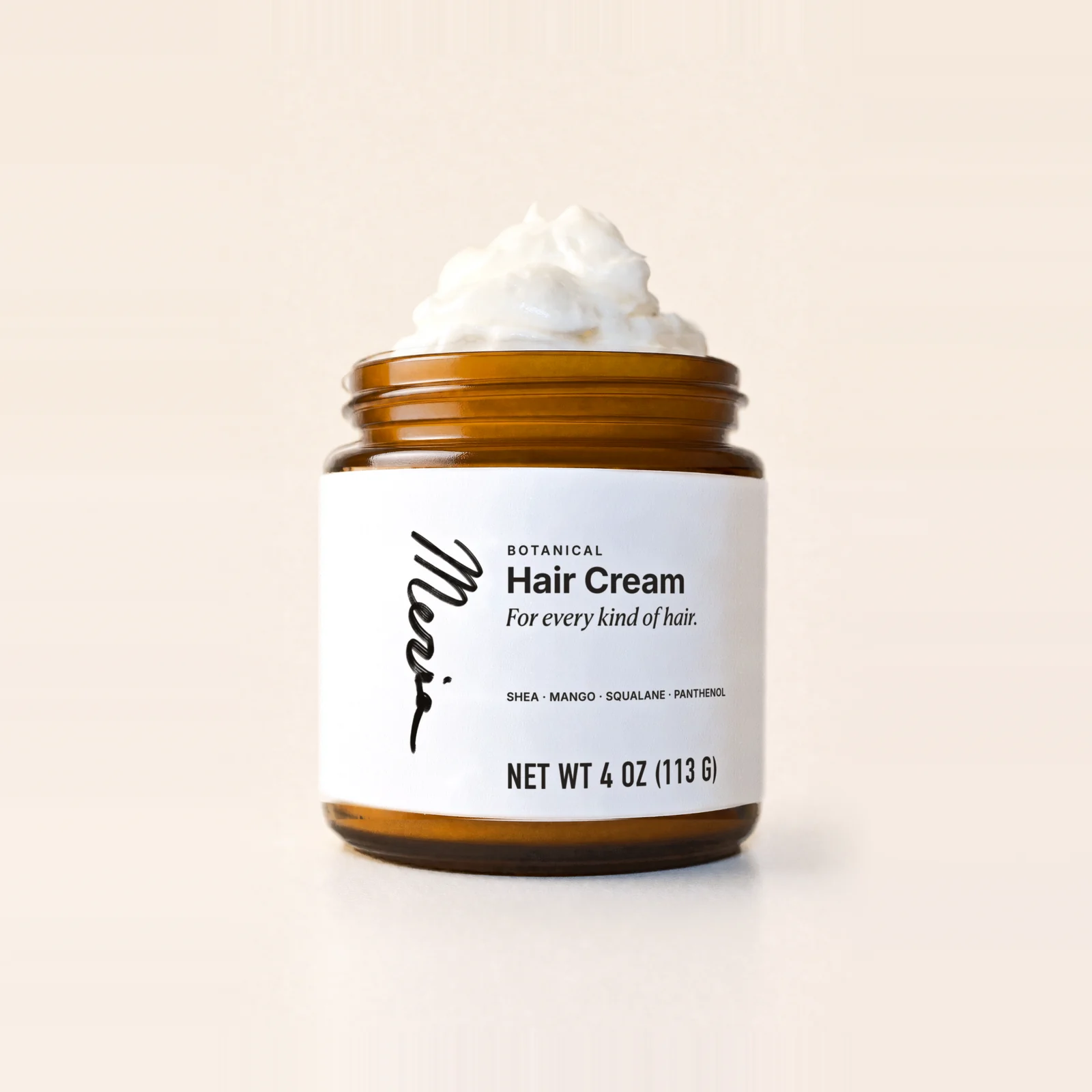
For every kind of hair.
Botanical Hair Cream, 4 oz / 113 g. Fragrance-free, one cream for straight, wavy, curly and coily hair.
Free US shipping.
5To use
Damp
After every shower, work Meria Hair Cream through damp hair: half a teaspoon for short or fine hair, a teaspoon for long, thick or curly hair.
Dry
Between washes, a little through the ends.
- Fine hair
- Start with half a teaspoon.
- Hold
- None. It conditions; it is not a styler.
- Scent
- None added. Fragrance-free.
- Contains
- Argan, shea, soy and a coconut-derived oil.
Read next
Sources
- 1Tham HP et al. Electrokinetic analysis reveals common conditioner ingredient interactions with human hair. Int J Cosmet Sci, 2026;48:379–93. Lab, cut hair, 1% rinsed off. Funded by A*STAR (Singapore); co-authors from Ashland, an ingredient maker. Read it
- 2Cameron DM et al. Confirmation of in vitro and clinical safety assessment of behentrimonium chloride-containing leave-on body lotions. Toxicol In Vitro, 2013;27:2203–12. 1–5%, no irritation in patch tests or home use. Kao USA. Read it
- 3Marsh JM et al. Strengthening benefits of panthenol for hair: mechanistic evidence from advanced spectroscopic techniques. Int J Cosmet Sci, 2026;48:121–7. Lab, cut hair. Procter & Gamble co-authors. Read it
- 4Gavazzoni Dias MF et al. The shampoo pH can affect the hair: myth or reality? Int J Trichology, 2014;6:95–9. Measured 123 shampoos; reviews the mechanism. Read it
- 5Patel HK et al. Structural changes in a cetostearyl alcohol/cetrimide/water gel after prolonged storage. J Pharm Pharmacol, 1985;37:899–902. How creams like this one hold their body. Read it
- 6Phong C et al. Coconut, castor, and argan oil for hair in skin of color patients: a systematic review. J Drugs Dermatol, 2022;21:751–7. No significant evidence that argan oil improves hair growth or quality. Read it
- 7Sharifi N et al. Argan oil as a pretreatment of human hair before exposure to oxidative damage. J Cosmet Dermatol, 2022;21:5010–7. Lab, cut hair. Read it
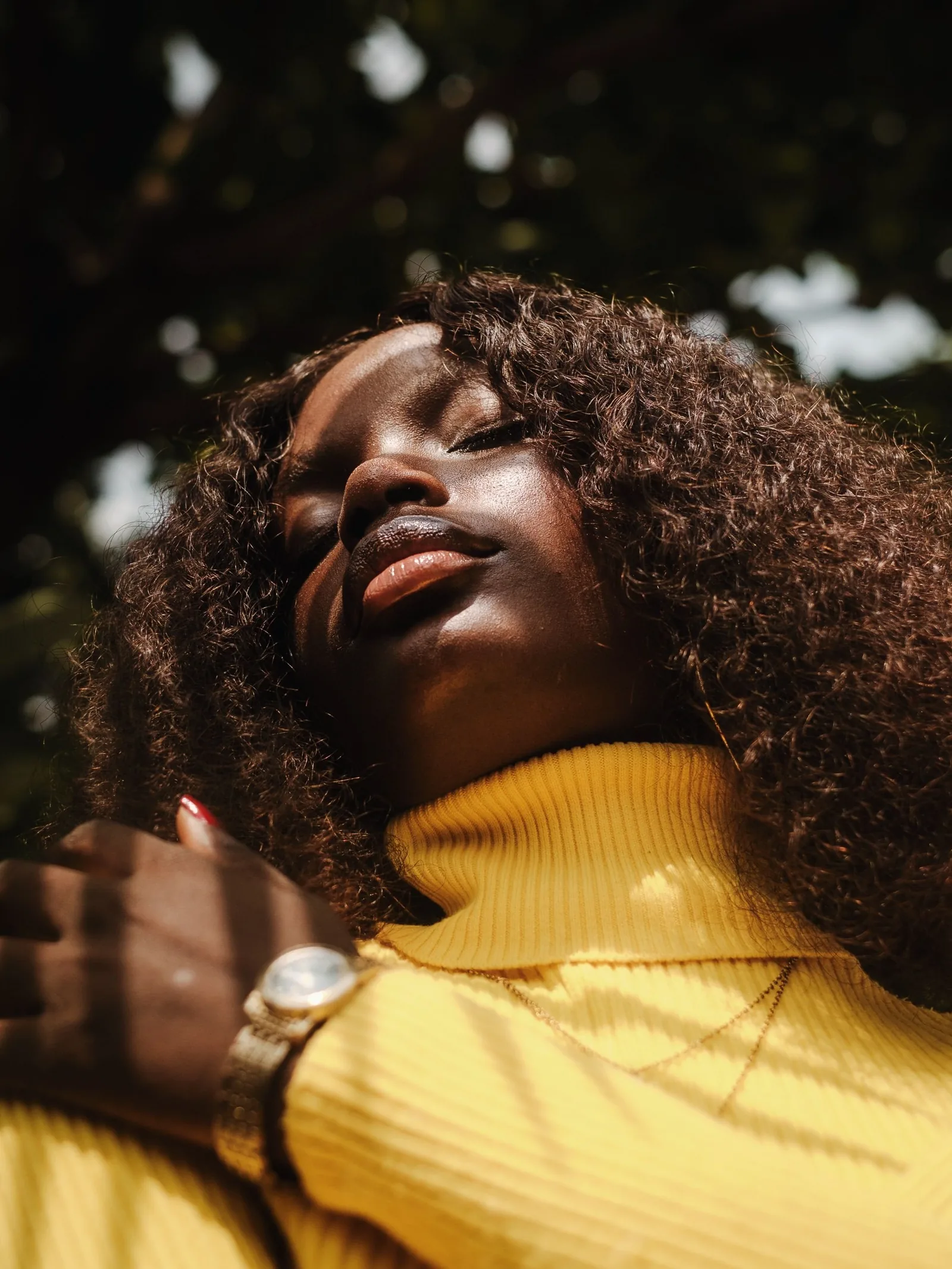
Photographs of people are illustrative (Pexels) and do not show Meria users. Nothing here is medical advice.