Meria · The creams, explained · November 2026
Rich enough for the body. Light enough for the face.
Meria Botanical Skin Cream, ingredient by ingredient, with the research behind each one and why they work together.
Bakuchiol and niacinamide, each at the strength its research tested. Four ingredients that hold water in the skin. Three butters and three light oils, so a cream rich enough for arms and legs sinks into the face within a minute.
For every study: how many people took part, for how long, and how much of the ingredient was used compared with Meria Skin Cream. Where the researchers worked for a company, the company is named.
1Bakuchiol, 0.5%
The plant alternative to retinol.
From the seeds of the babchi plant, for the look of fine lines and dark spots. In 2019 dermatologists at UC Davis put it head to head with retinol: 44 people, twelve weeks, and neither the patients nor the dermatologist grading them knew who had which cream. One group used 0.5% bakuchiol twice a day, the other 0.5% retinol once a day.
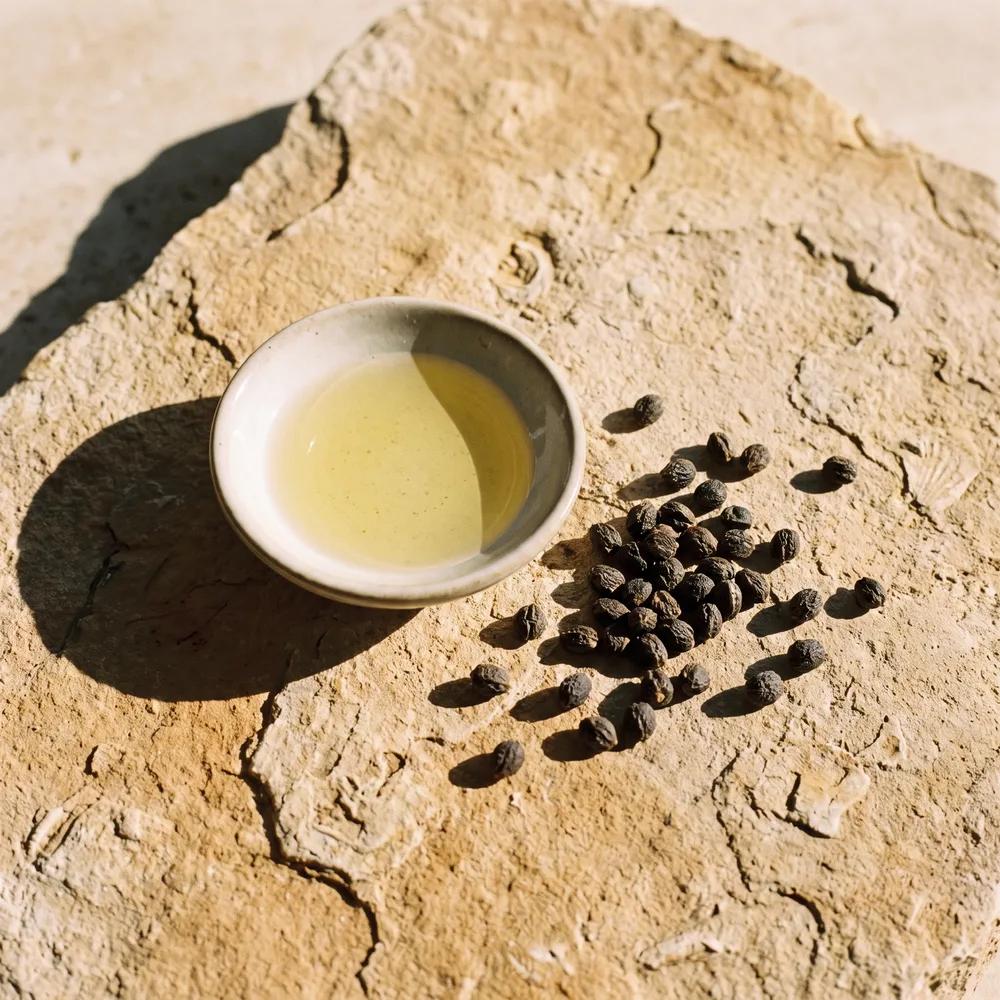
After 12 weeks, both groups had less wrinkle area and fewer dark spots, and the researchers found no significant difference between bakuchiol and retinol. Most other bakuchiol studies let people know which cream they were using, which makes their results less reliable. This one did not, so Meria Skin Cream uses the same 0.5% it tested.

The UC Davis trial tested bakuchiol at 0.5%.Every jar of Meria Skin Cream holds the same 0.5%.
Dhaliwal et al., British Journal of Dermatology, 2019
2Niacinamide, 4%
Vitamin B3, for lines, barrier and tone.
Lines
Thirty people used 4% niacinamide on one side of the face and a placebo on the other. After eight weeks, the fine lines around the eyes had improved on the niacinamide side. Meria Skin Cream uses the same 4%.
Kawada et al., 2008Barrier
On the skin, niacinamide raised its own ceramides, the lipids that hold water in, and dry skin lost less water. The study came from Kanebo, a cosmetics maker.
Tanno et al., 2000Tone
Niacinamide keeps pigment from passing from the cells that make it to the cells you see. In Procter & Gamble’s trials, at 5% and 2%, dark spots looked lighter after four weeks.
Hakozaki et al., 20023Water
Four ways to hold water.
Plump-looking skin is skin that holds its water. Four ingredients each take one part of that job, from the surface down. Panthenol, provitamin B5, helps keep the water there: in a 2011 study, 1% panthenol, the level in Meria Skin Cream, lowered the water lost through the skin after 30 days. Camargo et al., 2011
Butters and oils
Keep it from leaving.
Marula oil was moisturising and lightly occlusive in a study of 20 women.
Komane et al., 2015Hyaluronic acid
Holds it at the surface.
In 76 women over 60 days, creams with 0.1% hyaluronic acid improved hydration and elasticity. Meria Skin Cream uses 0.3%.
Pavicic et al., 2011Glycerin
Draws it into the skin.
Reviewed for hydration, barrier function and suppleness.
Fluhr et al., 2008Betaine
Keeps it inside the cells.
In a lab study on human skin, betaine raised the proteins that seal the gaps between cells.
El-Chami et al., 2021
Surface at the top, cells at the bottom.
4Together
Why these ingredients work together.
- 1
Lines and spots, two ways.
In lab models, bakuchiol acts much like retinol on the genes that renew skin. Niacinamide works on dark spots another way, by keeping pigment from reaching the surface cells.
- 2
Support for the barrier.
Niacinamide raises the skin’s own ceramides, the lipids that keep water in. Panthenol at 1%, the level in Meria Skin Cream, lowered water loss after 30 days of daily use.
- 3
Water, from the surface to the cell.
Glycerin draws it in, hyaluronic acid holds it at the surface, betaine keeps it inside the cells, and the butters slow its escape.
- 4
Less scaling, less stinging.
In its trial, bakuchiol caused less scaling and stinging than retinol did. In Meria Skin Cream it sits in a base with no fragrance.
No study has tested this formula as a whole, or bakuchiol and niacinamide together. Each line above rests on the studies named on this page. One thing this page does not claim: in a 2024 study, niacinamide did not ease the irritation retinol causes.
Everything in Meria Skin Cream, in label order
Water (Aqua), Butyrospermum Parkii (Shea) Butter, Glycerin, Mangifera Indica (Mango) Seed Butter, Niacinamide, Squalane, Shorea Stenoptera (Illipe) Seed Butter, Betaine, Glyceryl Stearate Citrate, Simmondsia Chinensis (Jojoba) Seed Oil, Sclerocarya Birrea (Marula) Seed Oil, Cetearyl Alcohol, Panthenol, Avena Sativa (Oat) Kernel Flour, Gluconolactone, Bakuchiol, Hyaluronic Acid, Tocopherol, Glycine Soja (Soybean) Oil, Sodium Benzoate, Sodium Phytate, Lactic Acid, Citric Acid, Calcium Gluconate, Pantolactone.
In pink, the ingredients this page explains. The rest keep Meria Skin Cream safe, stable and soft: a preservative, an emulsifier, vitamin E so the oils keep, and colloidal oat for its comforting feel. Fragrance-free, with no essential oils and no coconut oil. Every ingredient, and why
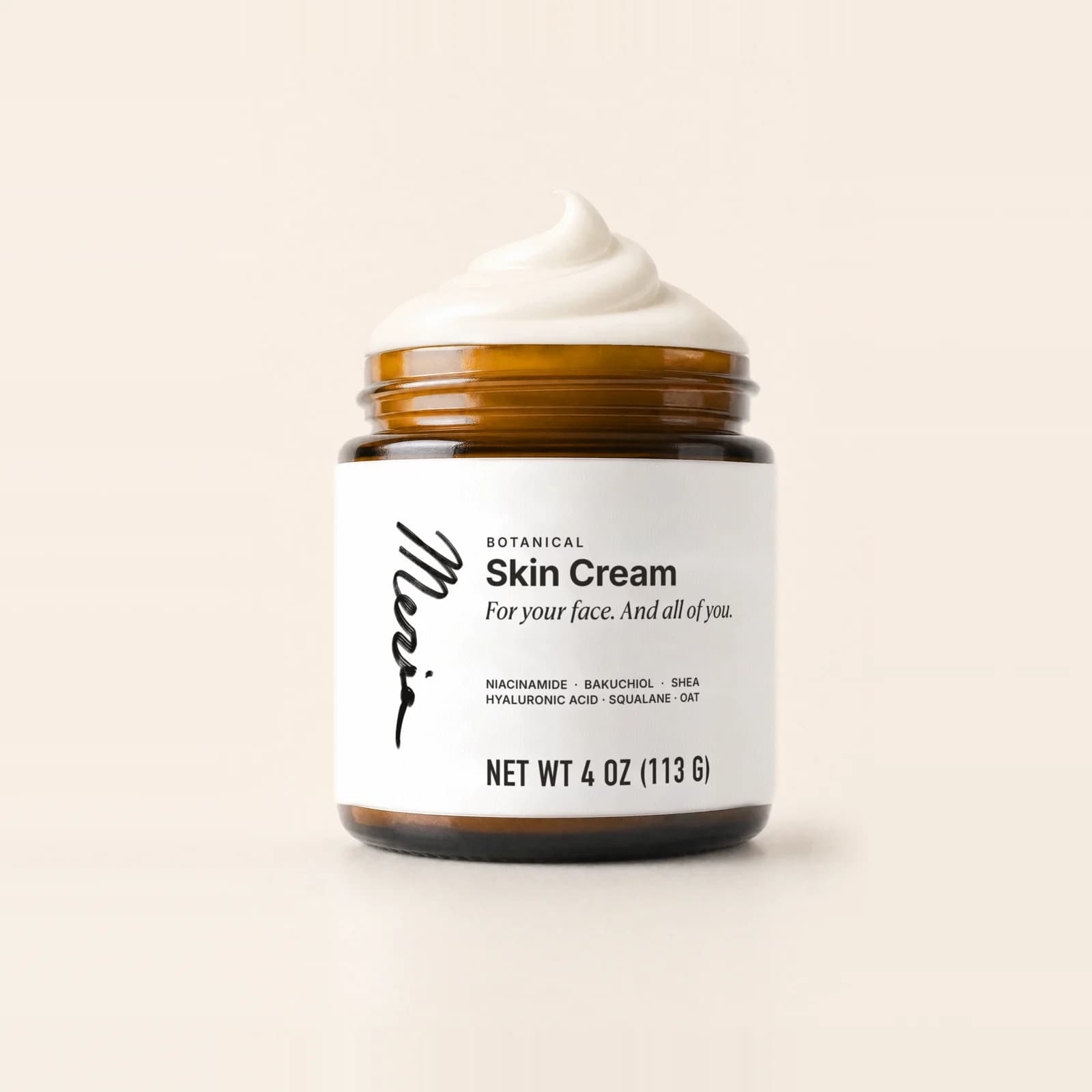
For your face. And all of you.
Botanical Skin Cream, 4 oz / 113 g. Fragrance-free, for face and body, morning and night.
Free US shipping.
5To use
Morning
Warm a little Meria Skin Cream between your fingers and smooth it over face, neck and anywhere else. Finish with sunscreen.
Night
Once more before bed. In the UC Davis trial, bakuchiol was applied twice a day, morning and night.
- Feel
- Rich going on, absorbed within a minute.
- With a retinoid
- Prescription first at night, Meria Skin Cream over it.
- Sensitive skin
- No fragrance, no essential oils. Patch test first.
- Contains
- Oat, shea and soy. No coconut oil.
Read next
Sources
- 1Dhaliwal S et al. Prospective, randomized, double-blind assessment of topical bakuchiol and retinol for facial photoageing. Br J Dermatol, 2019;180:289–96. 44 people, 12 weeks. Read it
- 2Chaudhuri RK, Bojanowski K. Bakuchiol: a retinol-like functional compound revealed by gene expression profiling. Int J Cosmet Sci, 2014;36:221–30. Lab; written by Sytheon, which makes the bakuchiol in Meria Skin Cream. Read it
- 3Fanning JE et al. Human clinical trials using topical bakuchiol: a systematic review. J Drugs Dermatol, 2024;23:239–43. 12 of the 15 trials let participants know which product they were using. Read it
- 4Kawada A et al. Evaluation of anti-wrinkle effects of a novel cosmetic containing niacinamide. J Dermatol, 2008;35:637–42. 4%, split-face, 30 people, 8 weeks. Read it
- 5Tanno O et al. Nicotinamide increases biosynthesis of ceramides. Br J Dermatol, 2000;143:524–31. Cells, then skin. Kanebo. Read it
- 6Hakozaki T et al. The effect of niacinamide on reducing cutaneous pigmentation. Br J Dermatol, 2002;147:20–31. 5% and 2%. Procter & Gamble. Read it
- 7Camargo FB et al. Skin moisturizing effects of panthenol-based formulations. J Cosmet Sci, 2011;62:361–70. 0.5, 1 and 5% on forearms, 30 days. Read it
- 8Proksch E, Nissen HP. Dexpanthenol enhances skin barrier repair. J Dermatolog Treat, 2002;13:173–8. Read it
- 9Pavicic T et al. Cream-based formulations of hyaluronic acid of different molecular weights. J Drugs Dermatol, 2011;10:990–1000. 0.1%, 76 women, 60 days. Read it
- 10Fluhr JW et al. Glycerol and the skin: holistic approach to its origin and functions. Br J Dermatol, 2008;159:23–34. Review. Read it
- 11El-Chami C et al. Organic osmolytes increase expression of tight junction proteins in skin. Br J Dermatol, 2021;184:482–94. Lab. Read it
- 12Komane B et al. Moisturising, hydrating and occlusive properties of marula oil. J Ethnopharmacol, 2015;176:327–35. 20 women. Read it
- 13Kim SK, Karadeniz F. Biological importance and applications of squalene and squalane. Adv Food Nutr Res, 2012;65:223–33. Review. Read it
- 14Fang Y et al. Mitigating retinol-induced irritation. J Cosmet Dermatol, 2024;23:2743–9. 3% niacinamide did not relieve retinol irritation; cited so no one claims it does. Read it
Photographs of people are illustrative (Pexels) and do not show Meria users. Nothing here is medical advice.